
الذكاء الاصطناعي يحل محل الوظائف: 7 علامات تحذيرية تدل على أن مسيرتك المهنية في خطر عام 2026

Imagine Sarah checking her email at 9 AM on a Tuesday.
There is no warning. No meeting. No chance to prove herself.
Her manager tells her that part of the company’s workflow has been automated and the team no longer needs her position.
For Sarah, it feels like it happened overnight.
لكن AI replacing jobs rarely starts with a layoff.
It usually starts much earlier.
A few tasks become automated. A new AI tool appears. Employees are expected to use it. The same team produces more work with fewer people. Job descriptions change. Entry-level positions become harder to find.
By the time a company removes a role, the real change may have been happening for months or even years.
ولهذا السبب فإن الفهم how AI replaces jobs matters more than simply asking whether artificial intelligence will take your job.
يشرح هذا الدليل 7 warning signs that your career may be becoming more exposed to AI, the types of jobs most affected, and what you can do now to stay employable.
Will AI Replace Jobs in 2026?
Yes, AI is already changing jobs in 2026.
But the story is more complicated than “AI will take everyone’s jobs.”
Current research suggests that AI is changing many jobs by automating individual tasks, changing workflows and increasing the amount of work one person can complete. Boston Consulting Group estimates that 50% to 55% of U.S. jobs could be reshaped by AI over the next two to three years, while emphasizing that task automation does not automatically mean job loss.
هذا التمييز مهم.
A job can change without disappearing.
A customer service representative may use AI to answer routine questions while handling difficult customer problems.
A writer may use AI to research and create first drafts while focusing more on editing, strategy and original ideas.
An analyst may use AI to process data while spending more time explaining what the data means and what the company should do.
لذلك عندما يبحث الناس عن “AI replacing jobs”, the better question is not:
“Which jobs will AI completely eliminate?”
أنه:
“Which parts of my job can AI do, and what will my role become after those tasks are automated?”
That question can help you see the risk much earlier.
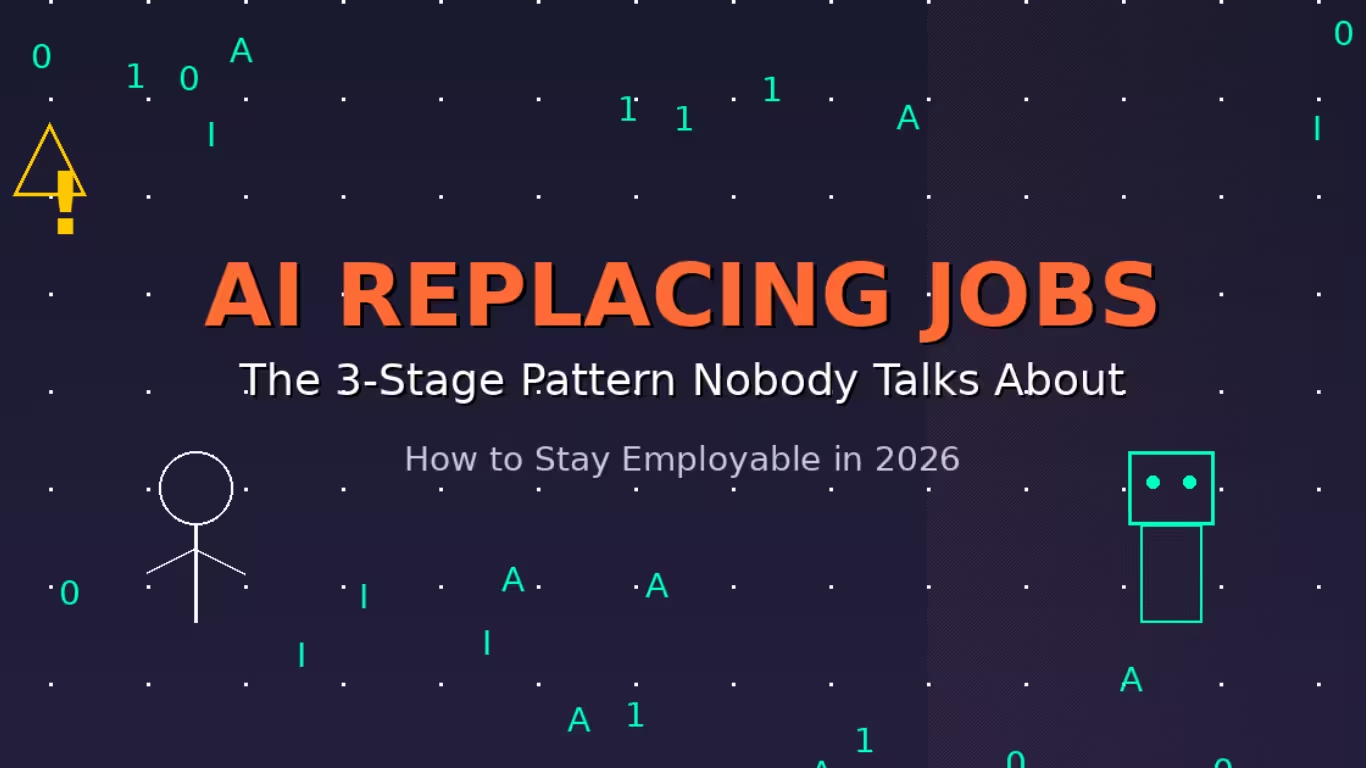
The 3-Stage Pattern of AI Replacing Jobs
There is no universal timetable for AI job replacement.
Different industries will move at different speeds, and some companies will adopt AI much faster than others.
But there is a useful pattern to watch.
Stage 1: AI becomes an assistant
AI helps workers complete existing tasks faster.
Stage 2: AI changes the workflow
The company redesigns the way work is done because AI can handle more of the process.
Stage 3: The role is reduced, redesigned or eliminated
The business needs fewer people to produce the same result, or the old job changes into a very different role.
النقطة المهمة بسيطة:
You want to start adapting during Stage 1 or Stage 2, not wait until Stage 3.
Stage 1: AI Becomes the Helpful Assistant
The first stage usually feels positive.
Your company introduces an AI tool that can:
- Write email drafts
- تلخيص الاجتماعات
- ابحث عن المستندات
- تحليل المعلومات
- إنشاء التقارير
- توليد الصور
- الإجابة على أسئلة العملاء
- تنظيم المعلومات
- أتمتة المهام المتكررة
Employees often think:
“This will make my job easier.”
وهي كذلك.
لكن هناك سؤال آخر يستحق الطرح:
“If this tool makes my work much faster, will my employer eventually need the same number of people?”
That doesn’t mean you should avoid AI.
العكس تماما.
Learning how to use AI can make you more valuable because you can produce better results with less wasted time.
The danger is becoming dependent on the old tasks that the technology is steadily making easier to automate.
Stage 2: AI Changes the Workflow
هذا هو المكان إزاحة وظيفة الذكاء الاصطناعي يصبح أكثر وضوحا.
The company stops thinking about AI as a simple employee tool and starts redesigning the entire workflow around it.
For example, imagine a company has ten employees handling customer requests.
AI begins answering the most common questions.
The ten employees now handle fewer routine requests.
Management notices that the team can handle the same customer volume with fewer people.
The company may then redesign the department.
Some employees may move into customer retention or complex problem solving. Others may take on different responsibilities. Some positions may not be replaced when people leave.
هذا أحد أهم جوانب الفهم AI automation jobs.
The first impact is not always a dramatic firing.
أحيانًا يكون الأمر كذلك:
- Fewer new hires
- فرق أصغر
- Fewer junior positions
- More work per employee
- Higher productivity expectations
- New AI requirements in job descriptions
- More automation inside existing roles
The job may still exist.
But the number of people needed to perform it can change.
Stage 3: The Role Is Reduced, Redesigned or Eliminated
Stage 3 is what most people imagine when they hear “AI replacing jobs.”
At this point, automation has become large enough to change the number or type of workers a company needs.
A company may:
- Reduce headcount
- Combine two positions
- Stop hiring for certain roles
- Move workers into new positions
- Replace a department’s manual process with software
- Eliminate a role
- Create a new AI-focused version of the old role
This is why waiting for an official announcement can be dangerous.
By the time someone says, “AI is replacing this job,” the organization may already have spent months changing the work behind the scenes.
The 7 Warning Signs Your Career Is at Risk
You do not need to predict the future perfectly.
Instead, watch what is happening around your work.
These seven signs can tell you whether your role is becoming more exposed to AI automation.
1. AI Can Already Do Your Most Repetitive Tasks
This is the clearest warning sign.
Look at your normal workday.
How much time do you spend:
- Copying information?
- Writing similar documents?
- Answering the same questions?
- Creating standard reports?
- Searching for information?
- Moving data between systems?
- Summarizing information?
- Performing predictable calculations?
- Following the same process repeatedly?
If AI can already perform a large part of those tasks, your job may be changing even if your job title remains exactly the same.
This does not mean your job will disappear.
It means you should start moving toward the parts of your work that require more judgment and responsibility.
2. Your Company Is Using AI to Produce More With the Same Team
Watch productivity changes.
If your team used to need ten people to complete a certain amount of work and AI allows the same team to handle significantly more, management will eventually notice.
يصبح السؤال بعد ذلك:
“What should we do with this extra capacity?”
Sometimes the answer is growth.
Sometimes it is new work.
Sometimes it is fewer hires.
Sometimes it is a smaller team.
هذا هو السبب إنتاجية الذكاء الاصطناعي can have both positive and negative effects for workers.
AI can make an employee more valuable while simultaneously reducing the number of employees needed for a particular process.
3. Your Job Description Is Becoming More AI-Focused
Pay attention to new job advertisements in your industry.
If employers increasingly ask for:
- محو الأمية الذكاء الاصطناعي
- أدوات منظمة العفو الدولية
- أتمتة
- AI workflow management
- Prompt skills
- تحليل البيانات
- البحث بمساعدة الذكاء الاصطناعي
- تقييم الذكاء الاصطناعي
- تنفيذ الذكاء الاصطناعي
the profession is changing.
That does not necessarily mean AI is eliminating the profession.
It may mean employers increasingly expect workers to know how to work مع منظمة العفو الدولية.
The World Economic Forum’s research shows that employers expect significant changes in the skills needed across the labor market, making continuous learning and reskilling increasingly important.
4. Your Entry-Level Tasks Are Disappearing
This warning sign matters especially if you are early in your career.
Many junior jobs historically included simple tasks that helped new workers gain experience.
AI can now perform some of those tasks.
That creates a difficult problem:
How do you gain experience if the tasks that traditionally gave beginners their first experience are increasingly automated?
The World Economic Forum has highlighted this change in early-career work, noting that strong entry-level workers increasingly need to know not only how to use AI, but when to use it, how to question its output and how to improve AI-assisted workflows.
The IMF has also warned that entry-level jobs have higher exposure to AI, creating particular challenges for people starting their careers.
The solution is not to panic.
It is to develop skills beyond basic task execution.
5. Your Work Can Be Measured Almost Entirely by Digital Output
اسأل نفسك:
Could an AI system or software judge whether my work was completed simply by checking the final digital result?
If the answer is yes, automation may be easier.
ومن الأمثلة على ذلك:
- المستندات القياسية
- التقارير الأساسية
- معالجة البيانات
- Routine translations
- حسابات بسيطة
- محتوى متكرر
- Standard customer responses
The more predictable the input and output, the easier it can be to automate.
6. Your “Complex” Work Is Becoming Less Complex
This is an easy warning sign to miss.
ربما تفكر:
“AI can’t replace me because my work is complicated.”
But complexity is not always protection.
If technology gradually handles the easier 20% of a task, then the easier 40%, then the easier 60%, the remaining human work can become increasingly specialized.
That does not automatically eliminate the profession.
It changes what the professional needs to be good at.
Your goal should therefore be to understand the next level of value في وظيفتك.
7. Your Company Is Redesigning Teams Around AI
This may be the strongest organizational warning sign.
ابحث عن:
- فرق أصغر
- سير العمل التي تركز على الذكاء الاصطناعي
- مشاريع الأتمتة
- New AI departments
- Fewer junior hires
- More AI-related responsibilities
- Employees being trained to use AI
- Software replacing manual processes
- Managers discussing efficiency or restructuring
Recent developments show why this matters. Some large companies have attempted major AI-driven organizational changes but have also discovered that AI implementation can be difficult, unreliable or less productive than expected. Meta’s 2026 workforce transformation effort is one example of how ambitious AI restructuring can run into practical and organizational problems.
So don’t assume every AI project will succeed.
But do pay attention when your employer starts changing the way work is organized.
Which Jobs Are Most at Risk From AI?
There is no perfect list of الوظائف التي سيحل الذكاء الاصطناعي محلها.
AI exposure depends on the actual tasks inside a job, the industry, the company, the technology available and how much human judgment is required.
However, jobs with large amounts of repetitive and predictable digital work can face greater automation pressure.
ومن الأمثلة على ذلك:
خدمة الزبائن
AI can handle many routine questions, while humans increasingly focus on complex cases, relationships and escalations.
ادخال بيانات
Software and AI can extract and organize information without requiring a person to manually enter every item.
Basic administrative work
Scheduling, document preparation, information sorting and routine communication can increasingly be automated.
Basic content production
AI can produce drafts, summaries, product descriptions and other routine content quickly.
التحليل الروتيني
AI can process large amounts of information and produce basic reports, reducing some manual analytical work.
مسك الدفاتر الأساسي
Accounting software can automate many repetitive financial processes.
General translation
AI translation can handle many straightforward communication needs, although human expertise remains important for specialized, sensitive and high-stakes work.
The important lesson is not:
“These jobs are dead.”
أنه:
“These jobs are changing, so the skills that make someone valuable in them are changing too.”
What About Jobs AI Can’t Replace?
كثيرًا ما يبحث الأشخاص عن ملفات “jobs AI won’t replace” or “AI-proof jobs.”
The honest answer is that no career can be guaranteed to be completely AI-proof.
Technology can affect almost every industry.
However, some work is more difficult to automate because it depends heavily on things such as:
- ثقة الإنسان
- الوجود المادي
- القيادة
- العلاقات المعقدة
- الذكاء العاطفي
- المساءلة
- التفاوض
- بيئات غير متوقعة
- Hands-on skills
- معرفة عميقة بالصناعة
For example, many healthcare, care, skilled-trade and relationship-based roles still depend heavily on human interaction and physical work.
Recent U.S. labor projections also show strong expected growth in healthcare and social assistance, including large gains in home health and personal care roles.
But even these jobs can use AI.
لذلك فكر في AI-resistant careers, not careers that are magically protected from technology.
AI Replacing Jobs vs. AI Changing Jobs
This distinction can completely change how you think about your career.
Suppose you are a writer.
AI can help you:
- مواضيع البحث
- Create outlines
- Generate drafts
- Summarize sources
- خلق الاختلافات
- تحقق من القواعد
That doesn’t necessarily mean writing disappears.
It means the job moves toward higher-value activities such as:
- افكار اصلية
- أبحاث
- تحرير
- الإستراتيجيات
- القص
- صوت العلامة التجارية
- فهم الجمهور
- حقيقة تدقيق
The same pattern can happen in many professions.
AI replaces some tasks while increasing the value of other tasks.
Research on AI and work continues to show this distinction between partial task automation and complete job loss.
Why Entry-Level Jobs May Be More Vulnerable
If you are a student, recent graduate or early-career worker, this section deserves your attention.
AI does not only threaten existing jobs.
It can also change the way people enter a profession.
A junior employee might once have spent several years doing routine work before gradually moving into more advanced responsibilities.
But if AI handles much of the routine work, companies may need fewer people at the bottom of the career ladder.
That can make AI replacing entry-level jobs an important issue.
The answer is not to skip basic knowledge.
You still need to understand your profession.
But you should also learn:
- How AI works at a practical level
- كيفية التحقق من مخرجات الذكاء الاصطناعي
- How to solve problems without blindly trusting AI
- How to improve AI-assisted workflows
- How your industry actually makes money
- How to communicate your ideas
- How to make decisions using imperfect information
The future worker is not simply someone who knows how to ask AI a question.
It is someone who knows whether the answer is useful.
The Skills AI Can’t Easily Replace
If you are worried about AI replacing your job, don’t try to beat AI at everything.
Build skills that work well alongside it.
التفكير النقدي
AI can give you an answer.
You still need to decide whether the answer is correct.
التواصل
Businesses still need people who can explain ideas, negotiate, persuade and work with others.
الذكاء العاطفي
Understanding people is important in leadership, customer relationships, teamwork and conflict resolution.
حل المشاكل
Real problems are often messy.
They may not have one correct answer.
حكم
A business decision can involve risk, money, reputation, customers and employees.
Someone still needs to make the final call.
الإبداع
AI can generate many ideas.
Human creativity is still valuable in deciding which ideas are useful, meaningful and appropriate.
الخبرة نطاق
Knowing an industry gives you context that a general AI system may not have.
القدرة على التكيف
The specific AI tools you learn today may not be the tools you use in five years.
The ability to learn new tools is therefore more durable than memorizing one tool.
How to Stay Employable in the Age of AI
You do not need to become a programmer.
You do not need to become an AI researcher.
And you do not need to learn every new AI tool.
You need to become good at using technology to create more value in your own field.
Step 1: Audit Your Tasks
Write down everything you do during a normal week.
Then divide your work into four groups:
A — Easily automated
AI can already perform most of it.
B — AI-assisted
AI can make you much faster.
C — Human-led
AI can help, but your judgment remains important.
D — Human-critical
The work depends heavily on trust, responsibility, physical presence or complex human decisions.
الآن اسأل:
“If someone removed Category A and B tasks from my job tomorrow, what valuable work would I still be able to do?”
That question can reveal your career risk.
Step 2: Learn AI for Your Actual Work
Don’t start by collecting 50 AI tools.
ابدأ بمشكلة واحدة.
Maybe you spend five hours every week creating reports.
Find an AI tool that can help.
Maybe you spend hours answering the same customer questions.
Build an AI-assisted response system.
Maybe you spend too much time researching.
Use AI to speed up the first stage of research, then verify important information yourself.
This approach makes AI learning practical.
Step 3: Move From Doer to Operator
A doer asks:
“How do I complete this task?”
An operator asks:
“What is the best way to achieve this result?”
The operator understands:
- ما الذي يجب أتمتته؟
- What should remain human
- Which tool should be used
- How the workflow should be designed
- How AI output should be checked
- When human judgment is needed
- How the final result affects the business
That is a powerful career position.
Step 4: Build a Hybrid Skill Stack
The strongest career strategy may not be choosing between AI skills and human skills.
It is combining them.
Think about combinations such as:
AI + Marketing
AI-assisted marketing, customer research and campaign strategy.
الذكاء الاصطناعي والتمويل
Financial analysis, forecasting and business decision support.
AI + Sales
Customer research, lead qualification and sales operations.
AI + Writing
Content strategy, editorial judgment and AI-assisted production.
AI + Design
Creative direction, brand strategy and AI-assisted design.
AI + Operations
Workflow automation, process improvement and AI implementation.
The more useful combination you can create, the harder it becomes to define your value by one easily automated task.
Step 5: Build Proof
Don’t simply tell an employer:
“I know AI.”
أظهر لهم.
You could demonstrate:
- How you reduced reporting time
- How you automated a repetitive process
- How you improved customer response
- How you created an AI-assisted workflow
- How you increased output without reducing quality
- How you trained coworkers to use a tool
- How you used AI while maintaining human quality control
Proof is more powerful than a list of AI buzzwords.
How to Future-Proof Your Career Against AI
You cannot guarantee that a career will never change.
But you can make yourself more adaptable.
A future-proof career strategy has four parts:
Keep your professional foundation
Understand your industry and your core skill.
Add AI literacy
Know what modern AI tools can do and where they fail.
Develop human strengths
Improve communication, judgment, creativity, leadership and problem solving.
الحفاظ على التعلم
Do not treat learning as something you finish after school.
The World Economic Forum estimates that a significant share of key workplace skills will change by 2030, reinforcing the importance of continuous upskilling and reskilling.
The goal is not to predict every future job.
It is to become someone who can move with the market.
What AI Skills Should You Learn in 2026?
You don’t need every AI skill.
Start with practical skills that apply to your work.
تشمل المجالات المفيدة ما يلي:
- محو الأمية الذكاء الاصطناعي
- Prompt writing
- البحث بمساعدة الذكاء الاصطناعي
- الكتابة بمساعدة الذكاء الاصطناعي
- تحليل بيانات الذكاء الاصطناعي
- أتمتة سير العمل بالذكاء الاصطناعي
- AI tool evaluation
- AI output checking
- وكلاء منظمة العفو الدولية
- أدوات إنتاجية الذكاء الاصطناعي
- Basic data skills
- AI-powered business workflows
For many non-technical workers, محو الأمية الذكاء الاصطناعي is a better starting point than trying to become a machine-learning engineer.
تعرّف على ما يمكن أن يفعله الذكاء الاصطناعي.
Learn what it cannot do.
Learn how to check its work.
Then learn how to apply it to a real business problem.
That is where AI skills become valuable.
What If My Company Does Not Allow AI?
هذا وضع شائع.
Some employers restrict AI tools because of privacy, security, intellectual property or compliance concerns.
Do not secretly upload confidential company information into public AI systems.
Instead, understand your company’s rules.
You can still develop your AI skills using:
- معلومات عامة
- المشاريع الشخصية
- Non-confidential examples
- Approved company tools
- بيئات التدريب
- Your own portfolio
The goal is not to break company policy.
The goal is to make sure you understand the technology before you need those skills.
What If AI Is Already Doing Part of My Job?
لا داعي للذعر.
This may actually be your opportunity to move into a more valuable position.
اطرح ثلاثة أسئلة:
What is AI doing?
Understand exactly which tasks are being automated.
What still needs a human?
Identify the parts requiring judgment, context, relationships or accountability.
Can I become the person who manages the new workflow?
هذا هو المفتاح.
Instead of competing with the AI system, become the person who knows how to use it properly.
Will AI Replace My Job?
Maybe parts of it.
Maybe the role will change.
Maybe the number of people needed to perform the role will decline.
Maybe the profession will grow in a new direction.
Nobody can honestly guarantee the answer for your specific job.
But you can estimate your risk.
اسأل نفسك:
1. How much of my work is repetitive?
2. How much of it happens entirely inside software?
3. Can AI already perform some of my main tasks?
4. Is my company investing heavily in automation?
5. Are fewer people needed to produce the same amount of work?
6. Are entry-level positions disappearing from my field?
7. Are employers asking for AI skills in new job postings?
If you answer “yes” to several of these questions, don’t wait for certainty.
Start adapting.
Frequently Asked Questions About AI Replacing Jobs
Will AI replace jobs in 2026?
AI is already changing jobs in 2026 by automating tasks, supporting employees, and changing business workflows. Some positions may shrink or disappear, but many jobs are being redesigned rather than completely eliminated.
What jobs are most at risk from AI?
Jobs with repetitive, predictable, and digital tasks can face higher automation pressure. Examples include some data-entry, administrative, routine customer service, basic content, and routine analysis work.
What jobs will AI replace first?
AI is generally more likely to automate individual tasks that are repetitive and predictable before replacing an entire occupation. Jobs heavily built around those tasks may therefore face greater pressure.
Will AI replace entry-level jobs?
Some entry-level work is particularly exposed because junior employees often perform routine tasks such as basic research, reporting, data preparation, and documentation. However, early-career workers who combine professional knowledge with AI skills can adapt to the changing workplace.
What jobs will AI not replace?
There are no jobs that can honestly be guaranteed to be completely safe from AI. However, careers involving physical work, human relationships, leadership, complex judgment, trust, and unpredictable situations may be more resistant to full automation.
What are the best AI-proof jobs?
It is better to think in terms of AI-resistant careers than completely AI-proof jobs. Careers that combine human interaction, specialized knowledge, physical work, judgment, and responsibility may be less vulnerable to full automation.
How can I avoid being replaced by AI?
Learn which parts of your job AI can automate, then develop skills that increase your value beyond those tasks. Learn to use AI, understand your industry deeply, improve your judgment and communication skills, and demonstrate measurable results.
What skills should I learn to stay employable?
Start with AI literacy and combine it with critical thinking, communication, problem solving, creativity, domain expertise, and adaptability. You do not need to learn every AI tool; focus on tools that solve real problems in your work.
Is learning AI worth it in 2026?
For many workers, yes. Employers are increasingly changing how work is performed around AI, so understanding how to use and evaluate AI can improve your ability to adapt. The most valuable skill is not knowing one specific AI tool but knowing how to apply AI effectively to real work.
كيف أضمن مستقبلي المهني في مواجهة الذكاء الاصطناعي؟
Build a combination of professional expertise, AI skills, and human strengths. Regularly review which tasks in your job are becoming automated and deliberately move toward work involving greater judgment, responsibility, creativity, relationships, and business impact.
Can AI replace entire professions?
It can contribute to the reduction or elimination of some roles, but complete occupational replacement is more difficult than automating individual tasks. Many professions are likely to change substantially before they disappear, and some will be redesigned around AI.
الخط السفلي
AI replacing jobs is real, but the biggest change is often happening inside jobs before it happens to jobs.
A task gets automated.
Then the workflow changes.
Then productivity expectations change.
Then companies reconsider how many people they need and what those people should do.
That is why you should not wait until your job is officially described as “at risk.”
Watch the work itself.
If AI is taking over your repetitive tasks, learn how to use it.
If your company is changing its workflow, learn where the new value is.
If entry-level tasks are disappearing, build skills beyond basic execution.
If employers are asking for AI skills, start developing them.
And if your job is changing, don’t automatically assume that change means the end of your career.
It may mean the beginning of a different version of it.
The workers who adapt best will not necessarily be the people who know the most about artificial intelligence.
They will be the people who understand their work, their industry, their customers and how to use AI to produce better results.
You don’t need to beat AI.
You need to become the person who knows how to work with it.





مبهر جدا