Top 10 AI Tools Trending in 2026

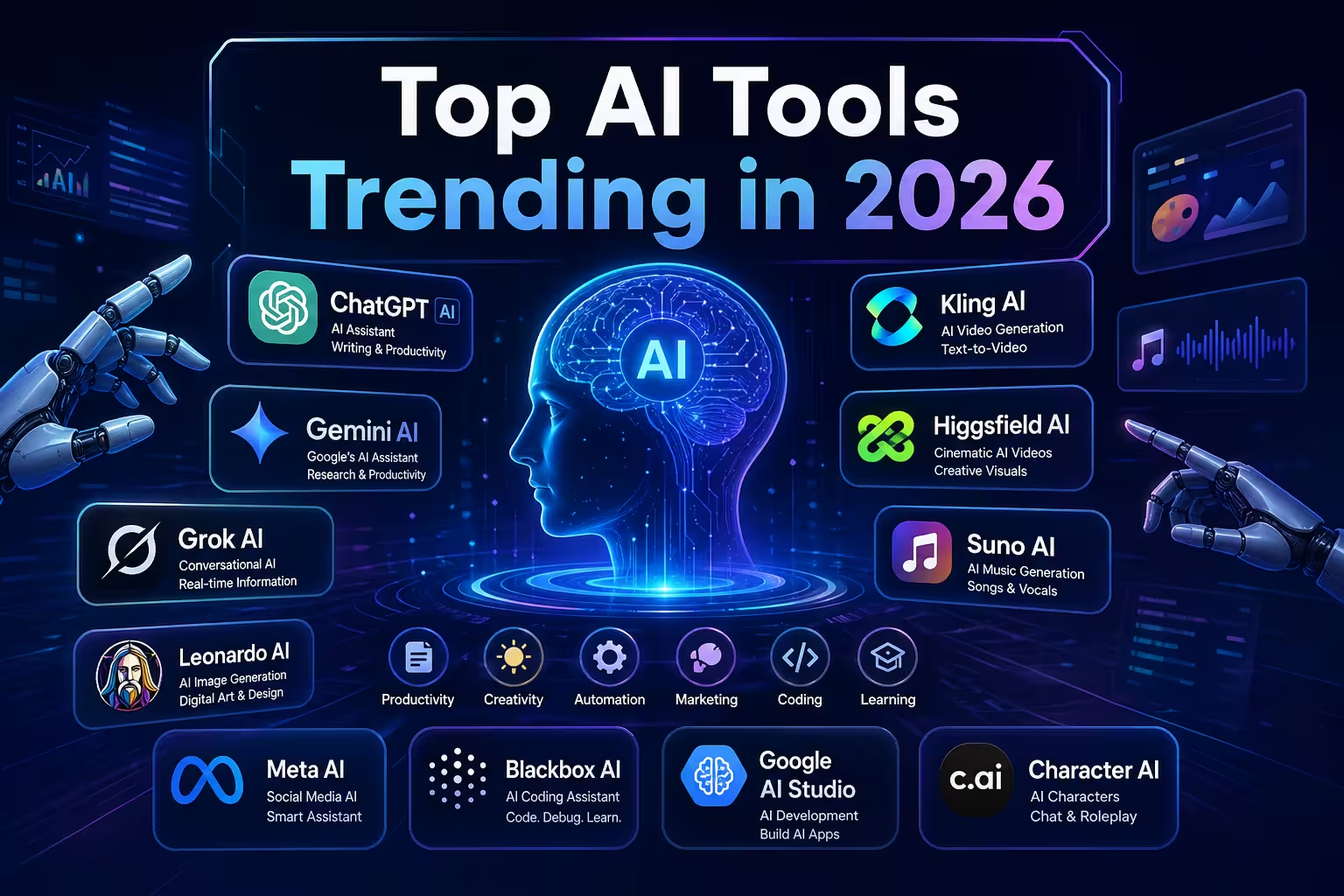





AI tools are changing how people work, learn, create content, build software, research information, and grow businesses. In 2026, the biggest AI tools are no longer limited to simple chatbots. Many can research information, create images and videos, write and edit content, help build software, generate voice, and automate business tasks.
But with thousands of AI tools available, choosing the right one can be difficult. This guide highlights 10 of the most useful and talked-about AI tools in 2026 and explains what each tool is best for, who can use it, and how it can help with everyday work or business.
Our focus is simple: these are not just AI tools that are popular. They are tools that solve different problems and can provide real value when used correctly.
1. ChatGPT
Best for: General AI assistance, writing, research, learning, brainstorming, analysis, and productivity.
ChatGPT is one of the most widely used AI tools and remains a strong all-purpose choice in 2026. It can answer questions, explain difficult subjects, write and rewrite content, summarize information, help with coding, analyze files, and support many other everyday tasks.
Its biggest advantage is flexibility. Instead of needing a separate AI tool for every small task, you can use ChatGPT as a general assistant and then add specialist tools when you need them.
You might also like

Why it is trending: ChatGPT continues to expand beyond basic conversations with tools for research, analysis, web search, file work, and other tasks depending on the plan and available features.
Good for: Students, writers, marketers, entrepreneurs, creators, developers, and everyday users.
Main limitation: ChatGPT is a general-purpose tool, so a specialist AI may perform better for some tasks such as professional image generation, coding inside a large software project, or advanced video production.
2. Claude
Best for: Writing, analysis, long documents, reasoning, and coding.
Claude is an AI assistant from Anthropic that has become one of the major alternatives to ChatGPT. It is particularly useful when you need help understanding large amounts of information, improving writing, analyzing documents, or working through complex problems.
You might also like

Claude can help write reports, review documents, explain ideas, analyze information, create content, and assist with software development. Its ability to work with long and detailed instructions makes it useful for people working on larger projects.
Why it is trending: Claude has become a major competitor in general AI assistants, while also becoming increasingly useful for coding and longer, more complex tasks.
Good for: Writers, researchers, business owners, developers, students, and professionals who work with large amounts of information.
Main limitation: Some advanced features and higher usage limits require a paid plan.
3. Gemini
Best for: General AI assistance, research, productivity, and people who use Google services.
You might also like

Gemini is Google’s AI assistant and one of the leading general-purpose AI platforms in 2026. It can help users answer questions, write content, analyze information, brainstorm ideas, study, and work with different types of content.
One of Gemini’s biggest strengths is its connection to Google’s wider ecosystem. This makes it particularly useful for people who already rely on Google products and services.
Why it is trending: Google continues to connect Gemini with more parts of its AI and productivity ecosystem, making it more than a standalone chatbot.
Good for: Students, professionals, researchers, creators, and Google users.
Main limitation: The best Gemini experience can depend on the Google services, plan, and features available to the user.
You might also like

4. Perplexity
Best for: Research, current information, fact-finding, and source-backed answers.
Perplexity is an AI answer engine designed to search the web and turn information from multiple sources into a direct answer. This makes it different from a traditional search engine because users can ask questions in normal language and receive a summarized response with sources.
It is especially useful when you need to research a topic instead of simply generating an answer from a general AI model.
Why it is trending: AI search and research are becoming important parts of how people find information online. Perplexity has also expanded its research and agent-style capabilities.
Good for: Researchers, students, marketers, writers, business owners, and anyone who needs current information.
You might also like

Main limitation: AI-generated research can still contain mistakes, so important information should be checked against the original sources.
5. Grok
Best for: Conversational AI, current topics, brainstorming, and information connected to public online conversations.
Grok is an AI assistant developed by xAI. It can answer questions, explain topics, help with ideas, assist with writing, and provide conversational responses.
Grok has gained attention because of its connection with the X platform and its focus on current events and public conversations. This makes it an interesting option for users who want an AI assistant connected to fast-moving online information.
Why it is trending: Grok is part of the growing competition between major AI assistants and is increasingly being used for current information, conversation, and creative tasks.
You might also like

Good for: Creators, researchers, social media users, and people interested in current topics.
Main limitation: Information about fast-moving topics should still be checked because online information can change quickly and may contain errors.
6. Cursor
Best for: AI-assisted coding and software development.
Cursor is an AI code editor built for developers. Instead of only suggesting individual lines of code, its AI agents can understand a codebase, edit multiple files, run commands, fix errors, and work through larger software tasks.
This is part of a major change in software development. Developers are increasingly using AI agents to handle parts of the development process while they review and guide the work.
You might also like

Why it is trending: AI coding is moving from simple autocomplete toward AI agents that can complete larger development tasks.
Good for: Developers, software teams, programmers, startups, and people learning to build software.
Main limitation: AI-generated code still needs human review. An AI coding agent can make incorrect changes or misunderstand how a project is supposed to work.
7. Midjourney
Best for: AI image generation, creative artwork, visual concepts, and design ideas.
Midjourney is one of the best-known AI image generation platforms. Users describe what they want with a text prompt, and the system creates images based on that description.
You might also like

It can be useful for creating visual concepts, artwork, campaign ideas, social media graphics, creative projects, and other types of digital imagery.
Why it is trending: AI image generation continues to improve, giving creators access to high-quality visual production without requiring advanced design skills.
Good for: Designers, creators, marketers, artists, bloggers, and businesses that need visual content.
Main limitation: AI-generated images may still need editing, and users should understand the platform’s current rules for commercial use before using generated work in business.
8. Runway
Best for: AI video generation and creative video production.
You might also like

Runway is an AI creative platform focused heavily on video. It gives creators tools for generating and editing visual content with AI, making video production faster and easier.
Instead of starting every video project with a camera and traditional editing process, creators can use AI to explore scenes, visual ideas, effects, and other parts of production.
Why it is trending: AI video has become one of the fastest-moving areas of generative AI, with creators and businesses looking for faster ways to produce video content.
Good for: Video creators, marketers, filmmakers, advertisers, social media creators, and businesses.
Main limitation: AI video can still require multiple attempts and editing to achieve the exact result you want.
You might also like

9. ElevenLabs
Best for: AI voice generation, narration, speech, and audio creation.
ElevenLabs is an AI audio platform known for realistic voice generation. It can turn written text into spoken audio and provides tools for creators and businesses working with voice and audio content.
Voice AI is useful when a project needs narration but recording a professional voice manually would take more time or resources.
Why it is trending: AI-generated voices are becoming more realistic and are being used across videos, education, media, games, marketing, and other digital content.
Good for: YouTubers, podcasters, video creators, marketers, educators, developers, and businesses.
Main limitation: Voice generation should be used responsibly. Users should have the proper rights and permission when creating or cloning a person’s voice.
10. Zapier
Best for: AI automation and connecting different business apps and workflows.
Zapier is different from most tools on this list because its main value is automation. It can connect applications and help businesses move information and tasks between them without requiring people to perform every step manually.
For example, a business can create workflows that move new customer information into another system, send notifications, organize leads, or trigger other actions after an event happens.
Why it is trending: AI is moving beyond generating content toward completing tasks and connecting different parts of a business workflow. Automation platforms can help turn AI into useful business processes.
Good for: Entrepreneurs, marketers, small businesses, agencies, operations teams, and professionals who repeat the same digital tasks.
Main limitation: Automation becomes more difficult to manage as workflows grow, so important business automations should be tested and monitored.
Best AI Tools by Use Case
There is no single AI tool that is best at everything. The right choice depends on what you want to accomplish.
| What you need | AI tool to consider |
|---|---|
| General AI assistance | ChatGPT |
| Writing and detailed analysis | Claude |
| Google-based productivity | Gemini |
| Research and current information | Perplexity |
| Current online conversations | Grok |
| AI coding | Cursor |
| AI images | Midjourney |
| AI video | Runway |
| AI voice and audio | ElevenLabs |
| Business automation | Zapier |
You do not need to subscribe to every AI tool. In most cases, it is better to choose one general AI assistant and add specialist tools only when they solve a problem you regularly have.
How to Choose the Right AI Tool in 2026
Before signing up for an AI tool, think about the task you want it to solve.
- Start with your goal: Decide whether you need help with writing, research, coding, images, video, voice, or automation.
- Try the free option first: If a free plan or trial is available, use it before paying.
- Compare the real benefit: A tool is valuable when it saves time, improves your work, or helps you complete something you could not easily do yourself.
- Check privacy: Understand how the service handles your information before uploading private business documents or sensitive data.
- Do not chase every new tool: AI changes quickly, but a tool is not automatically useful just because it is trending.
For businesses, the best AI tool is usually the one that fits into an existing workflow and produces a clear business benefit. Saving a few hours every week can be more valuable than collecting dozens of AI subscriptions.
Frequently Asked Questions About AI Tools in 2026
What are the best AI tools in 2026?
The best AI tool depends on what you need. ChatGPT, Claude, Gemini, Perplexity, Cursor, Midjourney, Runway, ElevenLabs, Grok, and Zapier are among the notable AI tools to consider in 2026 because they cover different areas such as general assistance, research, coding, images, video, voice, and automation.
What are the most popular AI tools right now?
ChatGPT, Claude, Gemini, Perplexity, and Grok are among the major general-purpose AI assistants. Specialist tools such as Cursor, Midjourney, Runway, ElevenLabs, and Zapier are also important for specific types of work.
Which AI tool is best for beginners?
ChatGPT, Gemini, and Claude are good starting points because they allow beginners to interact with AI using normal language. Start with simple tasks such as asking questions, summarizing information, brainstorming ideas, or improving writing.
What is the best AI tool for research?
Perplexity is a strong choice for web-based research because it searches online sources and provides cited answers. However, important information should always be checked against the original sources.
What is the best AI tool for coding?
Cursor is one of the leading AI coding tools for developers who want an AI assistant that can work directly with a software project. Other AI coding tools can also be useful depending on the programming environment and workflow.
What is the best AI image generator?
Midjourney is one of the leading AI image generation tools and is widely used for creating detailed visual concepts and artwork. The best choice can depend on the style, editing features, commercial needs, and workflow you prefer.
What is the best AI video generator?
Runway is one of the major AI video platforms to consider in 2026. AI video tools are changing quickly, so the best option depends on the type of video you want to create and the features available when you use the tool.
Are AI tools free?
Many AI tools offer free plans, trials, or limited free usage, while advanced features usually require payment. Free access and pricing can change, so check the tool’s official website before subscribing.
Can AI tools help a business make money?
AI tools do not automatically make money, but they can help a business save time, create content, research markets, improve customer service, automate tasks, and build products faster. The value comes from using AI to solve a real business problem.
Should I use more than one AI tool?
Yes, when each tool serves a different purpose. A practical AI setup could use one general assistant for everyday work, a research tool for finding information, and one or two specialist tools for tasks such as coding, design, video, or automation.
Final Thoughts
The most useful AI tools in 2026 are not necessarily the newest tools. They are the tools that help people solve real problems.
ChatGPT, Claude, Gemini, Perplexity, Grok, Cursor, Midjourney, Runway, ElevenLabs, and Zapier each have different strengths. Some help you think and write, some help you research, while others help you build software, create media, or automate business tasks.
For individuals and businesses, the goal should not be to use every AI tool available. Start with the problem you want to solve, choose the right tool, learn how to use it well, and measure whether it actually improves your work.
That is where AI becomes more than a trend. Used properly, it can become a practical part of how you work, create, and grow.