AI Digital Layer: Your AI Digital Twin That Works for You 24/7

Imagine having an AI that does more than answer your questions. It understands your goals, remembers the knowledge you choose to share, learns how you prefer to work, and helps you turn ideas into action.
Now imagine using that same AI to organize your personal life, support your business, preserve your experience, and help protect the knowledge you want future generations to remember.
This is the vision behind an AI Digital Layer.
As artificial intelligence develops, we are moving beyond systems that simply respond to instructions toward AI agents that can use tools, complete tasks, and work through multiple steps. This creates an opportunity to build a more personal relationship with AI, where useful context and clear goals guide the work it performs.
At Ezechax, we see the AI Digital Layer as a future in which people can build a personalized AI working system around their lives, ambitions, knowledge, and businesses.
The goal is not to replace who you are with a machine. It is to help you do more with what you know, reduce repetitive work, and preserve what matters.
In this guide, you will learn what an AI Digital Layer is, how a personal AI digital twin could work, how AI digital workers could help with everyday life and business, and how this technology could help people preserve their personal or business legacy.
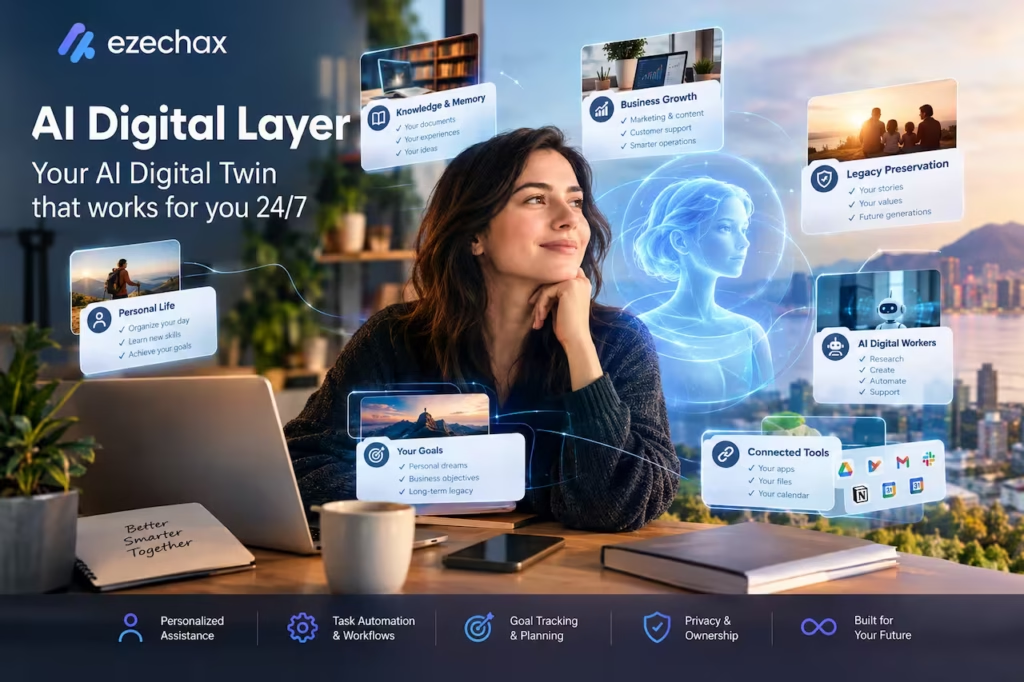
What Is an AI Digital Layer?
An AI Digital Layer is a proposed intelligent system that connects your personal knowledge, preferences, goals, digital tools, and AI workers to help you manage tasks and achieve meaningful outcomes.
Think of it as a working layer between you and your digital world.
Today, your information may be spread across documents, emails, notes, websites, calendars, business applications, and conversations. Your goals may exist in your mind or in separate plans. The tools you use may not share the context needed to help you work effectively.
An AI Digital Layer aims to bring relevant parts of that information together.
Instead of treating every task as an isolated request, it could use the context you have approved to help determine what you need, why you need it, and how the work fits into your larger goals.
For example, suppose you run an online business.
You want to publish useful articles, improve your website, attract customers, and increase revenue. A basic AI assistant might help you write an article when you ask.
A more connected AI Digital Layer could use your approved brand guidelines, previous content, customer research, marketing goals, and publishing schedule to help plan the article, prepare a draft, check for missing information, and organize the next steps.
You would still review important decisions and approve actions where necessary. The difference is that the AI could work with a broader understanding of your business instead of starting from scratch every time.
How an AI Digital Layer Works
A practical AI Digital Layer could bring together six connected capabilities.
Personal context: Information about your preferences, interests, working style, and goals.
Knowledge and memory: Approved information from your documents, notes, projects, past decisions, and other sources.
Goal management: A clear understanding of your priorities, deadlines, and desired outcomes.
AI digital workers: AI systems assigned to specific tasks, such as research, writing, planning, customer support, or administration.
Connected tools: Approved access to the applications and services needed to perform work.
Control and review: Permissions, activity records, feedback, and human approval for important actions.
These capabilities do not require one AI model to do everything. They can be built from several tools and services working together.
OpenAI’s documentation on AI agents explains how agents can use tools and manage multi-step work. It provides a useful technical foundation for understanding the kind of execution that an AI Digital Layer could coordinate.
The broader vision is to connect these capabilities around the person and their goals.
Why Personal Context Matters
An AI can produce a useful answer without knowing much about you. However, many tasks become more effective when the system has the right context.
Consider two people asking an AI to create a business plan.
One is a freelance writer who wants to attract more clients. The other runs an online store and wants to increase product sales.
Their goals, customers, resources, and daily work are different. They should not receive identical plans simply because they asked the same question.
A personalized AI system could use relevant information about each person’s situation to provide more suitable recommendations and prepare work that matches their needs.
The same principle applies to personal life. An AI that knows your preferred learning style, current projects, and personal goals may be able to offer more relevant help than a system that has no access to that context.
Personalization does not mean the AI knows everything about you. It means the system can use the information you choose to provide, along with its available tools and instructions, to make its assistance more relevant.
What Is a Personal AI Digital Twin?
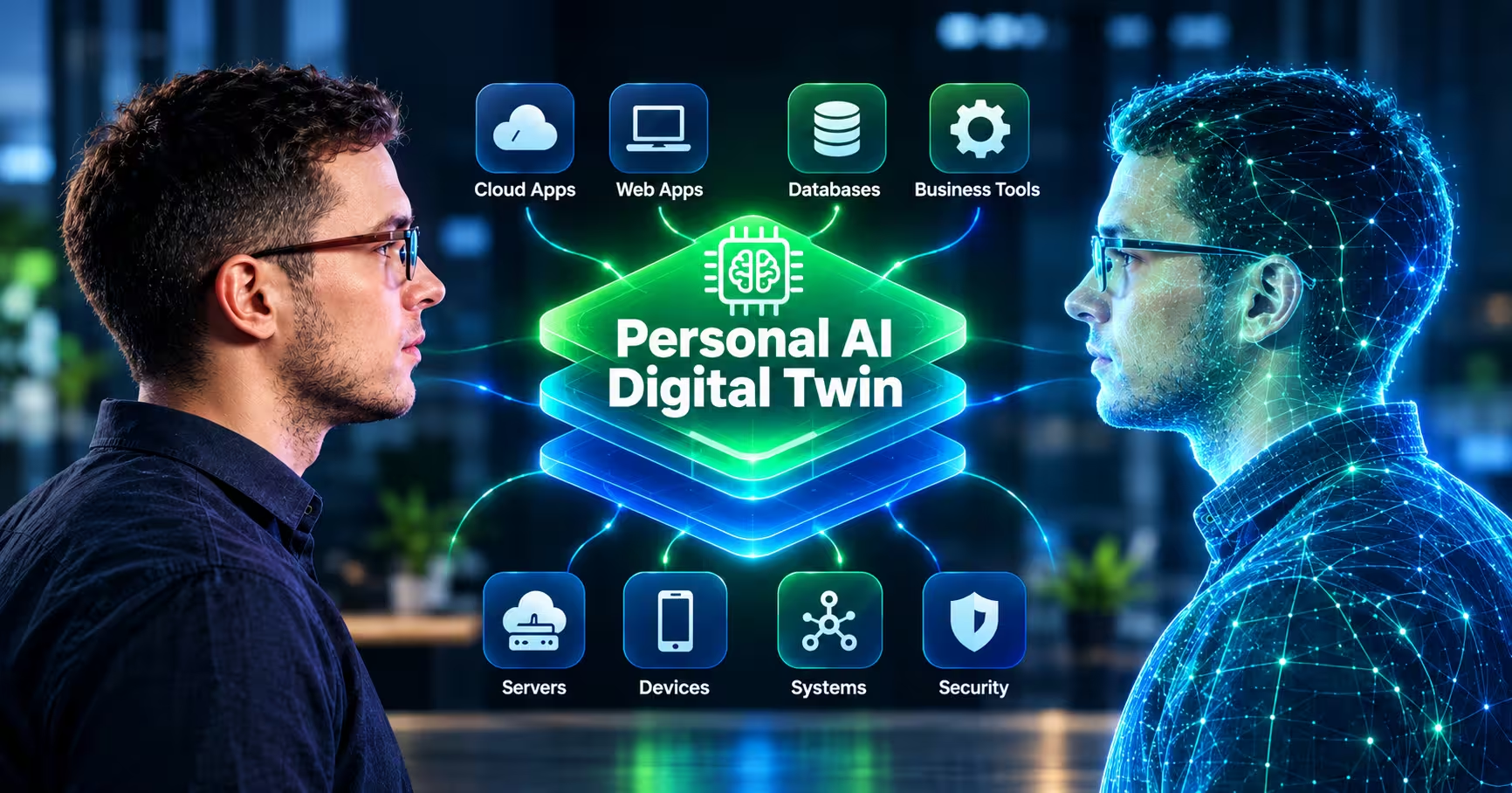
A personal AI digital twin is a digital representation of selected aspects of a person, such as their knowledge, preferences, experience, communication style, goals, and working methods.
The purpose is to create an AI system that can use this information to provide personalized assistance.
The term digital twin is used in different fields, including engineering, industrial systems, and personal AI. In this article, it refers specifically to a proposed personal AI representation, not a physical or medical simulation.
A personal AI digital twin could help you answer questions using your own records, prepare work in your preferred style, organize your ideas, or assist with projects that reflect your long-term goals.
For example, a writer could provide approved writing samples, editorial rules, research notes, and information about their audience. Their AI could use this context to prepare drafts that are closer to their usual style and standards.
A business owner could provide product information, customer questions, operating procedures, brand guidelines, and business objectives. Their AI worker could use those resources to help with customer support, content planning, research, and other tasks.
A parent or grandparent could record family stories, life lessons, personal values, and important memories. A carefully organized archive could help family members discover and learn from those records in the future.
These are possible applications, not guarantees that an AI can reproduce a person’s identity or understand their life completely.
Can an AI Really Understand Your Goals?
AI does not need to understand you in the same way another human does to provide useful assistance.
It needs reliable information about what you want to achieve, enough context to understand the task, and a way to check whether its work meets your expectations.
For example, you might tell your AI that your goal is to grow a business without sacrificing all your personal time.
A useful system could consider both parts of that goal. It might help identify repetitive tasks, prepare a weekly plan, suggest suitable automation, and show which activities need your attention.
Without the context about your time, the system might recommend more work simply because it sees more opportunities for growth.
This is why goals and personal preferences should be part of the design.
A good personal AI system should also allow you to correct its understanding. If your priorities change, it should use the updated information rather than continue working toward an outdated goal.
Your AI should help you pursue your intentions, not quietly decide what your intentions should be.
AI Digital Twin vs. AI Assistant vs. AI Agent
These terms are related, but they describe different aspects of AI.
| Concept | Main purpose | Example |
|---|---|---|
| AI assistant | Answers questions and helps with tasks | Drafting an email or explaining a topic |
| AI agent | Uses instructions and tools to carry out tasks or workflows | Researching a topic and preparing a report |
| Personal AI digital twin | Represents selected aspects of a person’s knowledge, preferences, or behavior | Using your approved records and preferences to personalize assistance |
| AI Digital Layer | Connects personal context, goals, tools, and digital workers into a broader working system | Coordinating personal projects, business tasks, and knowledge preservation |
An AI assistant can have memory. An AI agent can be personalized. A digital twin can be connected to tools. These categories overlap, so the distinction is about their primary roles rather than rigid technical boundaries.
The proposed Ezechax concept brings them together.
The AI Digital Twin provides personal context. The AI digital workers perform suitable tasks. The AI Digital Layer connects these capabilities to your wider goals and digital activities.
This distinction also explains why a personal AI digital twin should not be treated as an automatic replacement for a person.
It is a digital representation built from selected information. It may imitate aspects of someone’s writing or communication, but it can still misunderstand the person’s intentions, produce incorrect answers, or generate statements that the person never made.
A trustworthy system should make those limits clear.
How an AI Digital Worker Could Help With Everyday Life
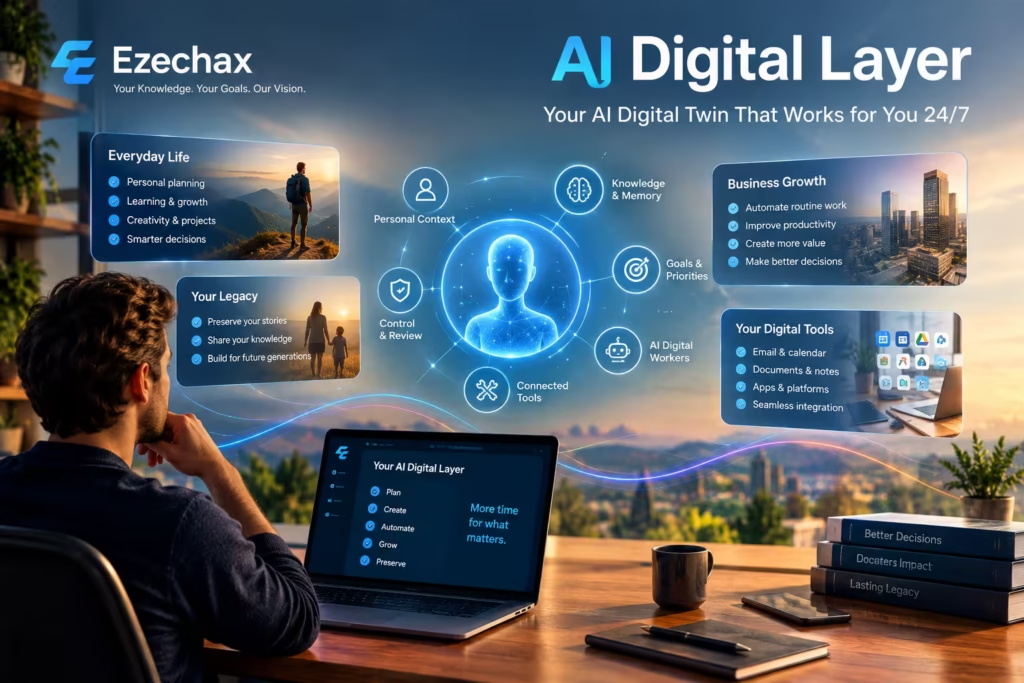
The value of a personal AI Digital Layer should extend beyond business operations. People have personal goals, relationships, responsibilities, interests, and creative ambitions that can benefit from better organization and suitable AI assistance.
Personal Planning and Organization
An AI digital worker could help organize tasks, prepare schedules, summarize information, and turn large goals into manageable steps.
Suppose you want to learn a new skill while managing your daily responsibilities.
Your AI could help build a learning plan, organize study materials, create practice exercises, and review your progress. If you approve access to your calendar or task manager, it could also help organize study sessions around your existing commitments.
You would remain in control of your priorities and schedule.
Learning and Personal Development
A personalized AI system could use your learning goals and approved study materials to explain difficult concepts, create exercises, and identify topics that need more attention.
It could also maintain a record of what you have studied and help you continue a project without having to reconstruct all the context yourself.
This could be useful for students, professionals learning new skills, independent researchers, and people exploring new interests.
AI-generated explanations still need to be checked against reliable sources, particularly when accuracy matters.
Writing, Creativity, and Personal Projects
Your digital worker could help organize ideas, prepare drafts, develop outlines, summarize research, and manage creative projects.
If you provide examples of your work and clear instructions, it could produce material that better reflects your preferences.
This does not mean the AI owns your creative vision or should make every decision for you. The strongest use is to reduce repetitive effort while leaving meaningful choices, originality, and final judgment in your hands.
Everyday Decisions and Reminders
A connected AI system could help compare options, prepare questions, organize important information, and remind you about tasks.
For example, it could help you prepare for a meeting by summarizing the relevant documents and listing the decisions that need attention.
However, an AI should not automatically make sensitive decisions about your health, finances, relationships, or legal responsibilities simply because it has access to your information. These areas require appropriate safeguards and human judgment.
The goal is to make everyday life easier to manage, not to hand over responsibility for your life.
How an AI Digital Worker Could Help Grow a Business
For entrepreneurs, freelancers, creators, and small business owners, an AI Digital Layer could become a way to coordinate work that currently requires many separate tools and repeated manual effort.
The most useful starting point is not to automate everything. It is to identify work that consumes time, follows a clear process, and can be checked reliably.
Building an AI That Understands Your Business
A business-focused digital worker needs access to relevant business knowledge.
This may include:
- Your products and services.
- Your target customers and their common questions.
- Your brand voice and content guidelines.
- Your marketing plans and business objectives.
- Your operating procedures and project records.
- Your previous decisions and lessons learned.
With appropriate permissions, this knowledge can help the AI prepare more relevant work.
For example, an AI working with an online business could use product information to prepare descriptions, research common customer questions, organize content ideas, and draft marketing materials.
The business owner could then review the results before they are published or sent to customers.
Automating Repetitive Work
Many business tasks involve repeated steps. These are often good candidates for carefully designed AI workflows.
A digital worker could help with research, reporting, content preparation, customer inquiry classification, document organization, or routine administrative work.
Consider a small business that receives many similar customer questions.
An AI system could classify incoming questions, retrieve answers from approved documentation, draft responses, and send straightforward replies if the business has explicitly authorized that behavior. Unusual or sensitive cases could be sent to a human.
This can reduce routine effort while keeping people involved where their judgment is needed.
AI agents can also be combined with other agents when a workflow requires different skills. Microsoft’s Work Trend Index examines the changing relationship between people and agents as AI takes on more execution.
The important point is that automation must be designed around the actual work. Adding AI to a poor process will not automatically make the process effective.
Using AI to Create More Value
Business growth depends on more than producing more content or completing more tasks. It also depends on creating something customers need, delivering it well, and building relationships that support long-term success.
A business-focused AI Digital Layer could help the owner spend less time on repetitive tasks and more time on product improvement, customer understanding, planning, and strategic decisions.
It could help identify unanswered customer questions, organize feedback, compare marketing approaches, or highlight unfinished projects.
These capabilities can support better decisions, but they do not guarantee more sales or profit. Results depend on the business model, product quality, market conditions, execution, and many other factors.
The purpose is to help people use their time and knowledge more effectively.
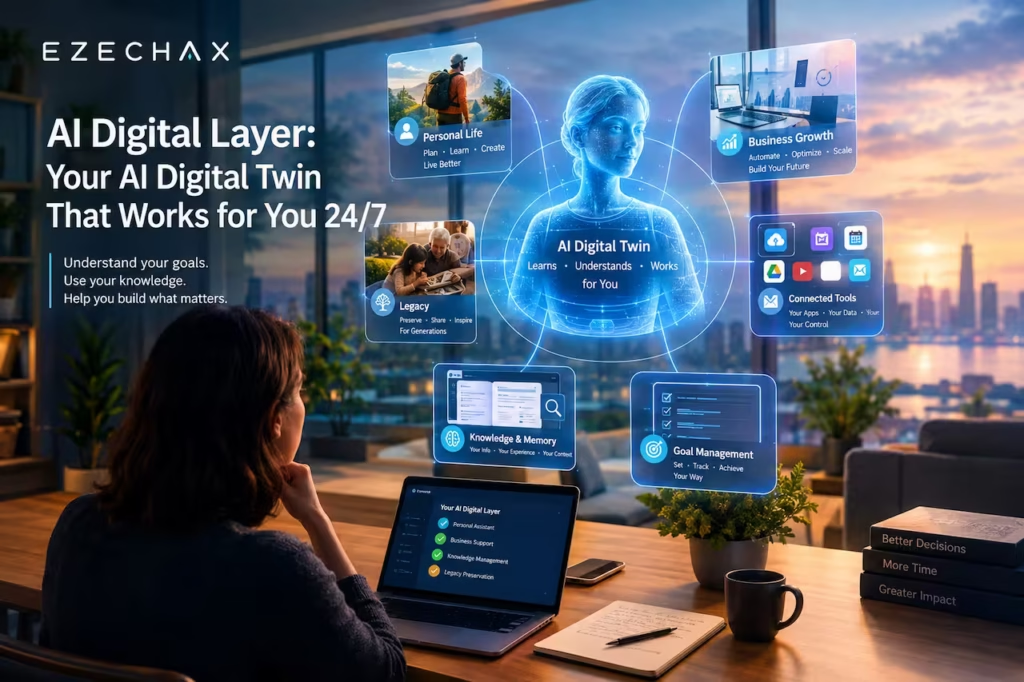
How to Preserve Your Personal or Business Legacy With AI
One of the most meaningful possibilities for a personal AI digital twin is the ability to preserve knowledge that might otherwise be lost.
People spend years developing skills, learning lessons, creating work, building relationships, and solving problems. Businesses develop their own knowledge through customer interactions, operating methods, product development, and experience.
Much of this information remains scattered across conversations, documents, personal memories, and the minds of a few key people.
A digital legacy system could help organize this knowledge so it remains useful.
Preserving Your Stories, Ideas, Values, and Experience
A personal legacy archive could include written stories, recorded memories, photographs, important documents, creative work, and lessons learned throughout life.
You might record why you made a major decision, what you learned from a difficult experience, or what you hope your children and grandchildren will understand about your life.
You could also document the principles that guide your work, your approach to solving problems, and the projects that matter most to you.
An AI system could help organize these records, create summaries, identify related topics, and answer questions using the material you have preserved.
For example, a family member might ask what you learned from building your first business. An AI archive could retrieve relevant stories and notes that you recorded.
The answer should distinguish your actual recorded words from AI-generated summaries or interpretations. It should not invent a memory and present it as a real event.
Building a Knowledge Base for Future Generations
Preserving information is only one part of a useful digital legacy. The information also needs to be organized, understandable, and accessible to the right people.
A well-designed archive could group material by topic, date, project, person, or life stage. It could include explanations of important documents and instructions about who may access particular records.
You might choose to keep some information private, share other material with family, and preserve selected stories for future generations.
An AI interface could make the archive easier to explore than a folder containing thousands of disconnected files.
However, the preservation of a digital archive does not guarantee that it will remain accessible forever. Long-term preservation also requires secure storage, backups, compatible file formats, account planning, and a clear process for transferring access when appropriate.
Preserving Business Knowledge for Continuity
Business legacy matters too.
A business owner may understand why certain processes exist, how key customer relationships developed, or what mistakes the company should avoid repeating. If that knowledge is never documented, it may disappear when the owner or an experienced employee leaves.
An AI-supported business knowledge base could help preserve operating procedures, product decisions, customer service principles, supplier information, and lessons from past projects.
A future business digital worker could use this information to help new team members understand established processes, locate relevant records, or prepare work according to documented standards.
For example, a founder could document how the company handles customer complaints, evaluates new product ideas, or maintains quality standards.
The knowledge would not make the AI a replacement for the founder. Instead, it would give the company a better record of the experience and systems the founder built.
Can an AI Digital Twin Continue Your Legacy After You Die?
An AI system may be able to preserve and present selected parts of your life story, work, and knowledge after your death, if the information and service remain available and the necessary permissions have been established.
It might allow future generations to explore your writing, listen to recordings, or ask questions about an archive of your documented experiences.
But this requires careful planning.
You should decide what information may be shared, who controls the archive, how an AI representation should be described, and whether it should be available after your death. You should also consider whether the service can export your records if the provider closes.
An AI representation is not the same as the person who created the information. It cannot guarantee that every response reflects their beliefs or wishes, and it should not claim to speak with their authority unless a statement is directly supported by the preserved record.
Research into AI afterlife technologies has raised ethical questions about consent, identity, privacy, and the risks of misrepresenting a person. See the 2026 research paper The Making of Digital Ghosts: Designing Ethical AI Afterlives.
For Ezechax, the responsible vision is to help people preserve and use their legacy, not to promise that a digital copy can replace them.
How an AI Digital Layer Could Work 24/7
The phrase works for you 24/7 describes the ambition of an AI system that can remain available and perform approved tasks outside the hours when you are personally working.
It does not mean that every AI system is always active, continuously thinking, or capable of completing every task without supervision.
A practical AI Digital Layer could combine several capabilities.
Memory, Goals, and Business Knowledge
The system could retain approved preferences and retrieve relevant information from a personal or business knowledge base.
When you begin a task, it could use that context to understand the objective and prepare a suitable plan.
For example, if your business goal is to publish helpful content every week, your AI could use your editorial guidelines and publishing plan to prepare draft topics or organize research.
The system would need clear instructions about which sources to use, what quality standards to follow, and when it should ask you for more information.
Connecting AI to Your Digital Tools
AI becomes more capable of completing work when it can interact with suitable tools.
Depending on the integrations available, a digital worker might access documents, calendars, project management systems, content platforms, or customer service software.
It could retrieve information, prepare changes, and perform approved actions through those tools.
Access should be limited to what each task requires. A content worker does not automatically need access to private financial records, and a research worker should not receive unrestricted permission to modify a website.
Scheduled and Proactive Assistance
A configured system could run scheduled tasks, check approved information sources, prepare reports, or notify you when a task needs attention.
For example, a business worker could prepare a weekly summary of unfinished projects and customer questions. Another could compile research for a planned article.
These tasks require scheduling, access to the relevant information, and a reliable execution environment. Some tasks may also depend on external services remaining available.
The AI should explain what it has completed, what remains unfinished, and what requires your approval.
When Should the AI Ask for Permission?
Not every action carries the same level of risk.
Drafting a private note may need little oversight. Sending a customer email, publishing a public statement, changing account settings, or spending money can have consequences that are harder to reverse.
A trustworthy digital worker should have clear permission levels. It may complete low-risk tasks automatically while asking for confirmation before sensitive or consequential actions.
This is an essential part of making an AI worker useful without giving it unlimited control.
What Information Does Your AI Digital Twin Need?
A personal AI digital twin does not need every detail of your life. It needs the right information for the tasks you want it to perform.
You could start with a few categories.
Your identity and preferences: Your role, interests, preferred communication style, and the way you like work to be organized.
Your goals: What you want to achieve, what matters most, and how you measure progress.
Your knowledge: Relevant notes, documents, research, work samples, and personal records.
Your methods: How you approach common tasks, make decisions, solve problems, and maintain quality.
Your boundaries: What information must remain private, which actions require approval, and what the AI should never do.
Your legacy instructions: What you want to preserve, who may access it, and how selected records should be handled in the future.
Start with information that is useful and appropriate to share. You can expand the system gradually as you learn which context improves the results.
You should also be able to correct outdated information. A useful personal AI must reflect your changing goals rather than treating old preferences as permanent instructions.
Privacy, Ownership, and the Limits of AI Digital Twins
A more personalized AI system may need access to more sensitive information. That creates responsibilities that should be addressed before the system is trusted with important work.
Control What Your AI Can Access
Only connect the information sources needed for a particular purpose.
Review the permissions granted to each application, and avoid giving an AI worker broad access simply because it might be convenient. Personal information, customer records, financial documents, and confidential business data deserve particular care.
Where possible, choose systems that explain how data is stored and used, provide meaningful privacy controls, and support exporting or deleting information.
The NIST AI Risk Management Framework provides a broader framework for considering the trustworthiness and risks of AI systems.
Understand the Difference Between Memory and Model Training
An AI that remembers your preferences does not necessarily train its underlying model on your personal data.
Personalization can work by storing approved information, retrieving relevant documents, maintaining task history, or applying saved instructions. These methods are different from changing the underlying model through training.
Before using a service, understand which method it uses, what information it retains, and what controls are available.
Keep Human Oversight for Important Decisions
AI can misunderstand instructions, produce inaccurate information, or use incomplete records. A system that remembers your preferences can still make mistakes.
Review important outputs, verify factual claims, and retain human approval for consequential decisions. Keep records of important actions so you can understand what happened and correct errors.
Plan for the Future of Your Digital Legacy
A digital legacy depends on more than the AI model. It also depends on your records, storage, account access, permissions, and the continued availability of the service.
Maintain backups of important material in accessible formats. Document how selected records should be handled, and consider how trusted people could access them when appropriate.
If you create an AI representation of yourself, make sure it is clearly identified as AI-generated and does not mislead people into believing that generated statements are direct quotations or confirmed personal beliefs.
The aim is to preserve knowledge responsibly while protecting the person behind it.
How to Start Building Your Personal AI Digital Layer
You do not need to build a complete digital twin before you can benefit from personalized AI. Start with one useful task and expand as your needs become clearer.
Step 1: Define What You Want Your AI to Help You Achieve
Choose a specific goal.
It might be organizing your personal projects, managing business research, creating content, preserving family stories, or documenting your company’s operating methods.
A clear goal makes it easier to decide what information and tools are actually necessary.
Step 2: Organize Your Useful Knowledge
Collect the relevant information in a manageable place.
For personal projects, this might include notes, plans, preferences, and learning materials. For a business, it might include product information, brand guidelines, operating procedures, and customer questions.
For legacy preservation, start recording stories, lessons, ideas, and important experiences in your own words.
Step 3: Choose an AI Tool That Fits the Task
Look for a tool that can handle your intended work and provides suitable controls for memory, data access, and privacy.
Some tasks require only a conversational assistant. Others may benefit from document retrieval, application integrations, or an agent that can perform multi-step workflows.
Do not choose a complex system before you know what problem you need to solve.
Step 4: Give the AI Clear Instructions and Boundaries
Explain the goal, provide relevant context, describe the expected result, and identify what the AI must not do.
For example, you might instruct a research worker to use credible sources, distinguish facts from assumptions, and prepare a report without publishing anything.
Clear instructions and limited permissions make it easier to check whether the work meets your expectations.
Step 5: Review the Results and Improve the System
Check the work, correct errors, and provide feedback.
If the AI repeatedly misunderstands a preference, update the relevant instructions or approved knowledge. If a task is unreliable, reduce its autonomy until you can trust the process.
Expand the system gradually, and keep track of whether it is actually saving time or improving results.
Step 6: Preserve Your Knowledge Outside a Single AI Service
If you want your knowledge to form part of a lasting personal or business legacy, keep your own accessible copies of important records.
Do not assume that information stored inside one AI application will always remain available.
Organize backups, record relevant context, and review your access and preservation plans over time.
This is how a useful personal AI system can grow from a simple assistant into a more connected working layer.
The Ezechax Vision for AI Digital Workers
At Ezechax, we believe AI should help people create more value from their knowledge, ideas, time, and effort.
Our long-term vision for the AI Digital Worker is to bring personal AI assistance, goal-oriented work, business support, and knowledge preservation into a more connected experience.
We call the broader concept the AI Digital Layer.
The idea is that your AI should not only respond to individual requests. It should be able to use the context you choose to share, understand the outcomes you are working toward, and help carry out suitable tasks through connected tools.
This vision extends beyond business automation.
It includes helping people organize their personal lives, develop their skills, manage creative projects, preserve important experiences, and build businesses that retain valuable knowledge as they grow.
It also recognizes that people are more than their productivity. Their stories, values, relationships, and experience may matter just as much as the work they produce.
A personal AI digital twin could help preserve selected parts of that knowledge. Digital workers could help put it to use. The wider AI Digital Layer could connect these capabilities to the person’s goals and priorities.
These are future product and service ambitions, not a claim that Ezechax currently provides a fully autonomous digital twin with every capability described in this article.
The technology, integrations, privacy controls, and operating systems needed to deliver this vision must be developed and tested over time.
The guiding principle is simple: your AI should help you do meaningful work, not take control away from you.
Your goals should guide the system. Your knowledge should make it more useful. Your permissions should define its boundaries. And you should remain able to review its work, change its direction, and decide what happens to the information you preserve.
The future of AI should not be measured only by how many tasks machines can perform. It should also be measured by how well they help people use their abilities, create value, and preserve what matters.
That is the future Ezechax wants to help build.
Frequently Asked Questions
What is an AI Digital Layer?
An AI Digital Layer is a proposed system that connects personal context, knowledge, goals, digital tools, and AI workers to help a person manage tasks and work toward their objectives. It is the broader concept behind the Ezechax AI Digital Worker vision.
What is a personal AI digital twin?
A personal AI digital twin is an AI-powered representation of selected aspects of a person’s knowledge, preferences, experiences, or working style. It can use this information to provide personalized assistance, but it is not the person itself and cannot perfectly reproduce their identity.
How is an AI digital worker different from a chatbot?
A chatbot mainly responds to messages and questions. An AI digital worker is designed to help complete tasks using instructions, tools, and workflows. Depending on its configuration, it may research information, prepare documents, organize tasks, or perform approved actions.
Can an AI digital twin work for me 24/7?
An AI system can be available around the clock and may perform scheduled or ongoing tasks when the necessary tools, permissions, and infrastructure are in place. Continuous availability does not mean every task can be completed autonomously or without errors.
Can I create an AI digital twin for my business?
You can begin building a personalized business AI system by organizing your business knowledge, documenting your goals, and using suitable AI tools. More advanced systems can connect that information to agents and business applications to help with approved workflows.
Can an AI digital twin preserve my legacy?
AI can help organize and present your stories, writing, memories, experience, and other records. A digital archive can help future generations explore that information, provided it remains accessible and the necessary permissions are in place. It cannot guarantee that an AI representation will accurately express everything you believed or intended.
Is an AI digital twin the same as an AI clone?
Not exactly. The term AI clone often suggests an attempt to imitate someone’s voice, appearance, or behavior. A personal AI digital twin can instead focus on representing selected knowledge, preferences, and experiences. The exact meaning depends on the system being developed.
Is an AI Digital Layer available from Ezechax today?
The AI Digital Layer described in this article is Ezechax’s future product and service vision. The capabilities discussed are proposed applications of AI technology, not a claim that a complete Ezechax digital twin product is currently available.
How can I start building a personal AI system?
Start by defining a goal, organizing the information relevant to that goal, choosing an AI tool with suitable capabilities, and setting clear permissions. Review its work and expand gradually as you learn which features provide real value.
Why should I preserve my personal or business knowledge?
Preserving knowledge can help you learn from past experiences, reduce repeated work, maintain business continuity, and pass useful information to other people. An organized digital archive can make important knowledge easier to find and use, both now and in the future.
Final Thoughts
You do not have to wait for a complete AI digital twin to begin building a more useful relationship with AI.
Start documenting what matters, organize the knowledge you want to keep, and use AI to help you work toward specific goals. As the technology develops, these foundations can support more personalized assistance and more capable digital workers.
The larger opportunity is to build a digital system that helps you use your knowledge today while preserving the ideas, experience, and work you want to carry forward.
Your life. Your knowledge. Your goals. An AI-powered layer to help you move forward.
That is the idea behind the Ezechax AI Digital Worker vision.